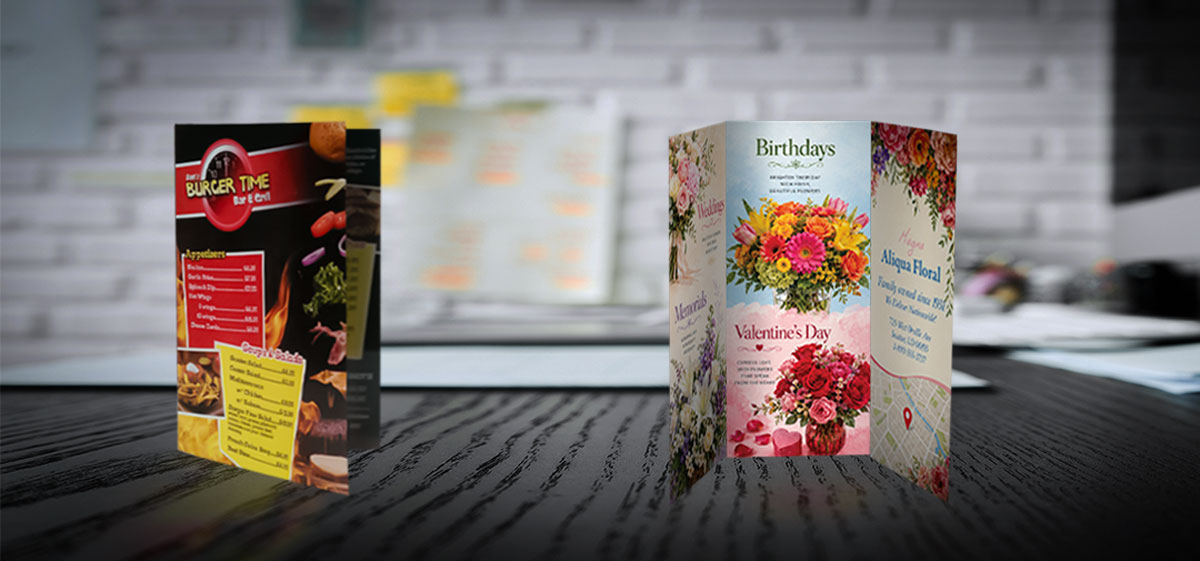
Tri-Fold vs. Bi-Fold Brochures: What's the Difference, and Which Fold Is Right for You?
Compare paper folds for printed brochures, including common uses, paper stock, panel orientation, pricing, and mailing requirements for tri-fold and bi-fold brochures.
Last Updated:
How you fold a printed brochure isn't just a design choice. It affects how your message gets read, how professional the piece looks, and how it can be mailed. Which fold is best for your printed piece depends on its purpose and how much information you include. One may be a better choice than another if you're advertising your business, promoting an event, or sharing information about your products and services.
Two popular brochure folding options are the tri-fold and the bi-fold. While both create a compact, easy-to-distribute piece, one or the other may be better suited for your particular content, paper stock, and budget needs.
Below is a comprehensive guide covering common uses, paper stock, panel orientation, pricing, and mailing requirements for both fold types.
What Are Tri-Fold and Bi-Fold Brochures?
Tri-Fold brochures, also called Letterfold or 3-Panel brochures, are made with two parallel folds that divide the sheet into three panels, with one panel folded slightly narrower so it tucks inside the other two.
Bi-Fold brochures, also called Half Fold, are made with a single fold down the middle of the sheet, creating two panels, or four pages total when printed front and back.
Quick Look: Tri-Fold vs. Bi-Fold Brochures
Tri-Fold | Bi-Fold | ||||||||
|---|---|---|---|---|---|---|---|---|---|
Fold Structure: | Two parallel folds, one panel tucks inside the other two | One fold down the center of the sheet | |||||||
Panel Count: | Three panels per side (six panels total) | Two panels per side (four panels total) | |||||||
Finished Size:(folded from 8.5" x 11") | 8.5" x 3.67" | 8.5" x 5.5" | |||||||
Reading Style: | Unfolds panel by panel in sequence | Opens like a book, side by side | |||||||
Best Use: | Direct mail, letters/envelope inserts, product overviews, service brochures | Direct mail, event programs, menus, greeting cards | |||||||
Common Uses of Tri-Fold and Bi-Fold Brochures:
Tri-Fold
- Direct mail brochures
- Product and service overviews
- Event and trade show handouts
- Real estate flyers
- Sales and marketing collateral
Bi-Fold
- Direct mail
- Restaurant menus
- Event programs
- Product one-sheets
- Service overviews
- Simple price lists
What Paper Stock Works Best?
Tri-Fold
Mid-weight stocks such as 32/80# Text Gloss or 100# Text Gloss are common choices, since they fold cleanly across two crease lines while still feeling substantial. Lighter text weights such as 28/70# Text Smooth are also popular for high-volume mailers where low cost is the priority.
Bi-Fold
Because there's only one fold, bi-fold brochures handle a wider range of stocks comfortably, including heavier text weights and light cover stocks. Cover stocks provide a sturdier feel than text weight paper, which can feel a bit bulky with a tri-fold.
Which Panel Faces Out?
Tri-Fold
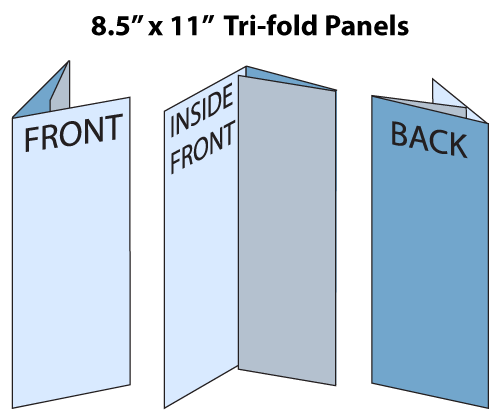
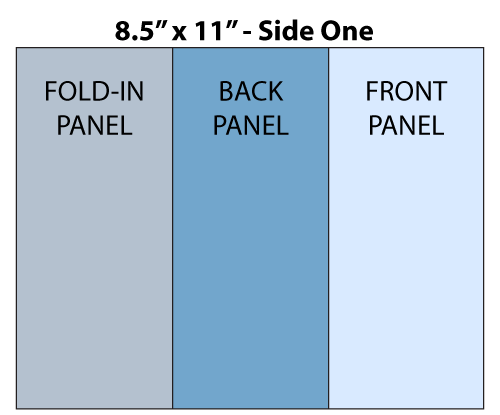
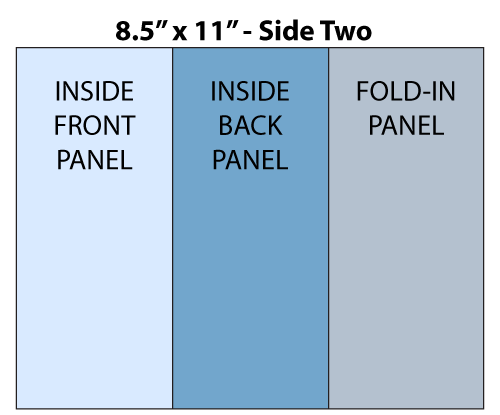
The right panel of the first side becomes the "front cover" and faces out after folding, while the center panel becomes the "back cover" and also faces out. The narrower tuck-in panel folds to the inside, staying hidden until the brochure is opened.
Bi-Fold
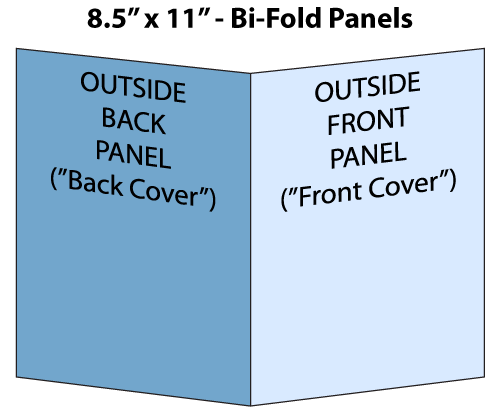
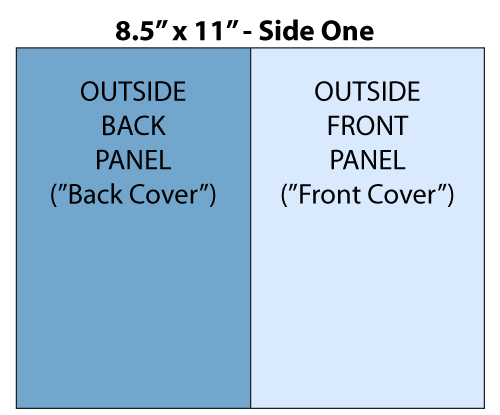
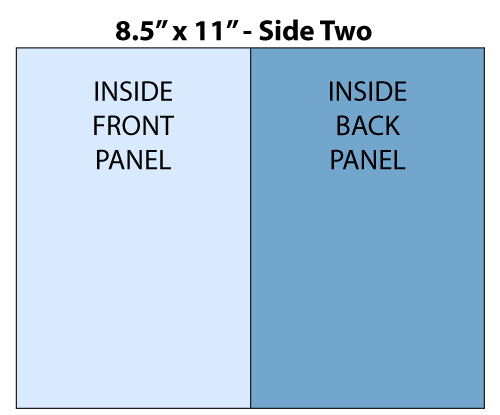
The right panel of the first side becomes the "front cover," while the left panel becomes the "back cover." With only one fold, both inside panels are revealed together as a single spread when the brochure is opened.
Panel Layout Guides
Tri-Fold Panel Layout
Bi-Fold Panel Layout
Do Heavier Paper Stocks Need to Be Scored?
We recommend scoring when printing on 32/80# Text or heavier. Scoring creates a compressed crease line that helps paper fold cleanly without cracking the coating or fibers along the fold.
Because a tri-fold brochure has two fold lines instead of one, scoring is especially important on heavier stocks to keep both creases sharp and crack-free. Bi-fold brochures, with a single fold, are somewhat more forgiving, but scoring is still recommended at these heavier weights.
Is a Tri-Fold Brochure More Expensive Than a Bi-Fold?
No, both tri-fold and bi-fold brochures have the same cost for folding and scoring. However, bi-fold brochures are often printed on 11x17 paper, while tri-folds are usually 8.5x11. The paper size affects the cost, but the folding price remains the same.
Can Tri-Fold and Bi-Fold Brochures Be Mailed?
Yes, both can be mailed as self-mailers, where sheets are printed, addressed, folded, sealed shut, and mailed without an envelope. However, tri-fold and bi-fold brochures have distinct USPS requirements for the mailing panel since panel size, tab placement, and address positioning vary by fold type.
See how to design the mailing panel on a folded self mailer for panel dimensions and mailing requirements for each fold type.

Pros and Cons:
Tri-Fold
Pros
- Six panels (three per side) give more room to lay out a message in sequence.
- Compact, mailer-friendly finished size.
- Familiar format that's widely recognized for direct mail and sales pieces.
- Well suited for layered content like an intro, details, and a call to action.
Cons
- Narrower panels than a bi-fold, with less room per section.
- The tucked-in panel needs a slightly narrower width, which adds a design step.
- Not ideal for a single large image or graphic that needs to span the whole piece.
Bi-Fold
Pros
- Simple, booklet-style layout that's easy to design.
- Wider panels than a tri-fold, better for large images or graphics.
- Cost-effective and quick to produce.
- Familiar format that's easy for readers to navigate.
Cons
- Larger finished size than a tri-fold, less compact for mailing.
- Only four panels (two per side), which limits content to a more concise message.
- Less layout structure than a tri-fold for guiding readers through several points.
Frequently Asked Questions:
What is a tri-fold brochure?
A tri-fold brochure, also called a letterfold or 3-panel brochure, is a sheet folded twice using two parallel folds. This creates six panels (three per side), with one panel slightly narrower so it tucks inside the other two.
What is a bi-fold brochure?
A bi-fold brochure, also called a half-fold brochure, is a sheet folded once down the middle to create four panels (two per side) that open and read like a booklet.
What's the difference between a tri-fold and a bi-fold brochure?
The main difference is the number of folds and panels. A bi-fold uses a single fold to create two wider panels, while a tri-fold uses two parallel folds to create three narrower panels, with one panel tucking inside the others.
Which brochure fold is better, tri-fold or bi-fold?
It depends on the project. Bi-fold brochures work well for concise, easy-to-read content like menus or one-sheets. Tri-fold brochures suit layered content like direct mail pieces, product overviews, or sales collateral with several talking points.
Is a tri-fold the same as a letterfold?
Yes. Tri-fold and letterfold refer to the same folding style, in which two parallel folds divide the sheet into three panels, with one panel tucking inside the other two.
What paper stock works best for tri-fold and bi-fold brochures?
Mid-to-heavy-weight stocks like 28/70# Text Smooth, 32/80# Text Smooth/Gloss or 100# Text Gloss work well for both fold types. Tri-fold brochures generally do best on lighter to mid-weight stock since they fold across two crease lines, while bi-fold brochures can comfortably handle heavier stock since they only have one fold.
If you don't need a glossy finish, the 28/70# Text Smooth paper offers a more affordable option that is still a nice quality.
Do heavier paper stocks need to be scored before folding?
Yes, heavier and coated stocks such as 32/80# Text Smooth/Gloss and 100# Text Gloss should typically be scored before folding to prevent cracking along the crease, especially for tri-fold brochures, which have two fold lines instead of one.
We're unable to score 32/80# Text Gloss, so if having a glossy finish and clean fold lines are both important, select 100# Text Gloss instead.
Which panel faces out on a tri-fold brochure?
The front panel and back panel face outward. These correllate with the right-side panel and center panel on an unfolded sheet. The middle panel and the narrower tuck-in panel fold to the inside and stay hidden until the brochure is opened.
Is a tri-fold brochure more expensive than a bi-fold brochure?
No. The price of tri-fold brochures and bi-fold brochures are the same when printed on the same paper size. But many bi-fold brochures are printed on 11x17 while tri-fold brochures are generally 8.5x11. In this case, bi-fold brochures cost more, although the cost of the folding and scoring remains unchanged.
Can tri-fold and bi-fold brochures be mailed without an envelope?
Yes, both can be mailed as a self-mailer. Tri-fold and bi-fold brochures have distinct USPS requirements for the mailing panel, so panel size, tab placement, and address positioning need to match the fold type being used.
Conclusion:
Both tri-fold and bi-fold brochures offer effective ways to present printed information, but each suits different needs. The right choice depends on content volume, paper stock, budget, and how the piece will be distributed. For simple, easy-to-read content, a bi-fold brochure provides a clean and familiar format. But for layered content like direct mail pieces or sales collateral, a tri-fold brochure offers a familiar, sequential presentation.
 Processing...