Published:
Choosing the right paper for printing can feel confusing, especially when you're comparing paper weights, finishes, and terms like bond, text, and cover stock. If you've ever wondered “What paper should I use for flyers?”, “What's the difference between 80# text and 100# cover?”, or “Which paper is best for brochures, postcards, or book printing?”, we have good news: you're not alone, and you've come to the right place.
The paper you choose has a huge impact on how your printed material looks, feels, and performs. Whether you're working on custom printing projects like documents, booklets, marketing materials, or postcards, this guide will help you understand your options and choose the best paper stock for your needs.
What does paper weight mean?
Paper weight describes how heavy, thick and sturdy a sheet feels. These factors affect how your printed piece looks, handles and performs, so it's important to have a strong working knowledge before beginning your custom printing project.
In digital printing, paper weight is commonly listed in pounds (# or lb) using standard production sheet sizes. Selecting an appropriate paper weight helps support reliable feeding through digital presses, consistent image quality and the right level of durability for the finished piece.
Because different customers may be coming from a digital printing or offset printing background, most of the paper stocks below show both the digital and offset weight. For example, in the case of 20/50# Bond, 20# refers to the weight of a 500-sheet ream of 11" x 22" paper commonly used in digital printing. On the other hand, 50# refers to 500 sheets of 25" x 38" which is a common sheet size for offset printing.
Paper weight vs. paper thickness in points (pt)
Paper thickness is often referenced in points (pt) to make it easier to compare stiffness across different paper types. One point equals 1/1000 of an inch, so higher point values indicate a thicker, stiffer sheet. Paper weight (lb) and thickness (pt) are related, but they are not the same. Coated papers and cover stocks may be slightly thicker or thinner in points than uncoated papers at the same listed weight.
Digital printing paper weights at a glance

- Bond and text weights (20–32#): lighter, flexible papers commonly used for letters, forms, brochures, manuals and multi-page documents.
- Cover weights (65–130#): heavier, more rigid card stock papers used for business cards, postcards, book covers, sell sheets and marketing pieces.
- Point thickness (pt): a direct measurement of sheet thickness that helps compare stiffness across paper types and coatings.
How do paper types affect print quality?
Paper type and surface finish influence color, contrast, glare and how crisp your text and images appear.
Uncoated copy paper typically provides excellent readability and is easy to write on, while coated papers tend to increase color saturation and image contrast. For digital printing, the right combination of paper weight, finish and coating helps your piece look intentional and professional.
Gloss Paper Spectrum (less sheen to more sheen)
Relative positions for common digital printing papers. Left is less gloss, right is more gloss.
Paper type definitions
Bond paper (uncoated)
Bond paper is an uncoated copy paper designed for easy reading and writing. It has a matte-like surface that accepts toner cleanly with minimal glare, which makes it well suited for text-heavy documents, forms and everyday business printing. Bond papers are often listed in the 20–32# range and typically have a lower point thickness than coated stocks.
Smooth Paper (uncoated)
Smooth paper is an uncoated stock with a more refined surface than bond. It has a smooth, matte-like finish which is more consistent than uncoated bond paper. It supports sharp text and clean graphics while maintaining strong readability and writability. Smooth papers come in text weights and cover weights, are commonly selected for booklet pages, professional reports, letterhead, business cards, and postcards.
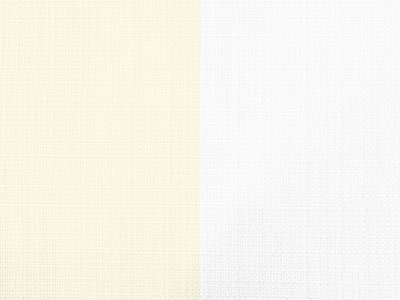 Linen Paper Stocks
Linen Paper (textured, uncoated)
Linen paper is an uncoated paper with an embossed crosshatch texture that resembles woven fabric. The textured surface adds a tactile, upscale feel while still supporting clear text and moderate color reproduction. Linen stocks are commonly used for letterhead, certificates, invitations and professional business materials where appearance and touch are important.
Because of its textured surface, linen paper can slightly reduce image sharpness compared to smooth papers, making it better suited for text-focused designs than detailed photographs.
Semi-gloss Paper (coated)
Semi-gloss paper has a light coating that improves color and image contrast while reducing glare compared to a full gloss finish. It provides a balanced appearance that works well for flyers, brochures and marketing pieces that include text and photos/graphics. This is very similar to Satin paper, but with slightly more sheen. All of the gloss-labeled paper stocks we carry, except for the 12pt C1S High Gloss Cover, are technically semi-gloss.
High Gloss C1S Cover Stock (Coated One Side)
High Gloss C1S cover stock is a heavy paper coated on one side only. The coated side has a bright, photo-like glossy finish that helps colors appear more vibrant, while the back is uncoated and easier for writing. This stock is commonly used for postcards, book covers and premium promotional pieces. High Gloss C1S is often thicker and commonly measures about 10–14pt depending on weight.
Coated C2S cover stock (coated two sides)
Coated C2S cover stock is coated on both sides for consistent color and image quality across the front and back. It is not as glossy as semi-gloss or High Gloss C1S, but it still has a slight shine that enhances graphics while maintaining a more refined finish. C2S cover stocks are frequently used for menus, business cards, postcards and durable marketing materials.
Common Paper Types and Use Cases
Below are some real-world examples of common use cases for various paper stocks and finishes.
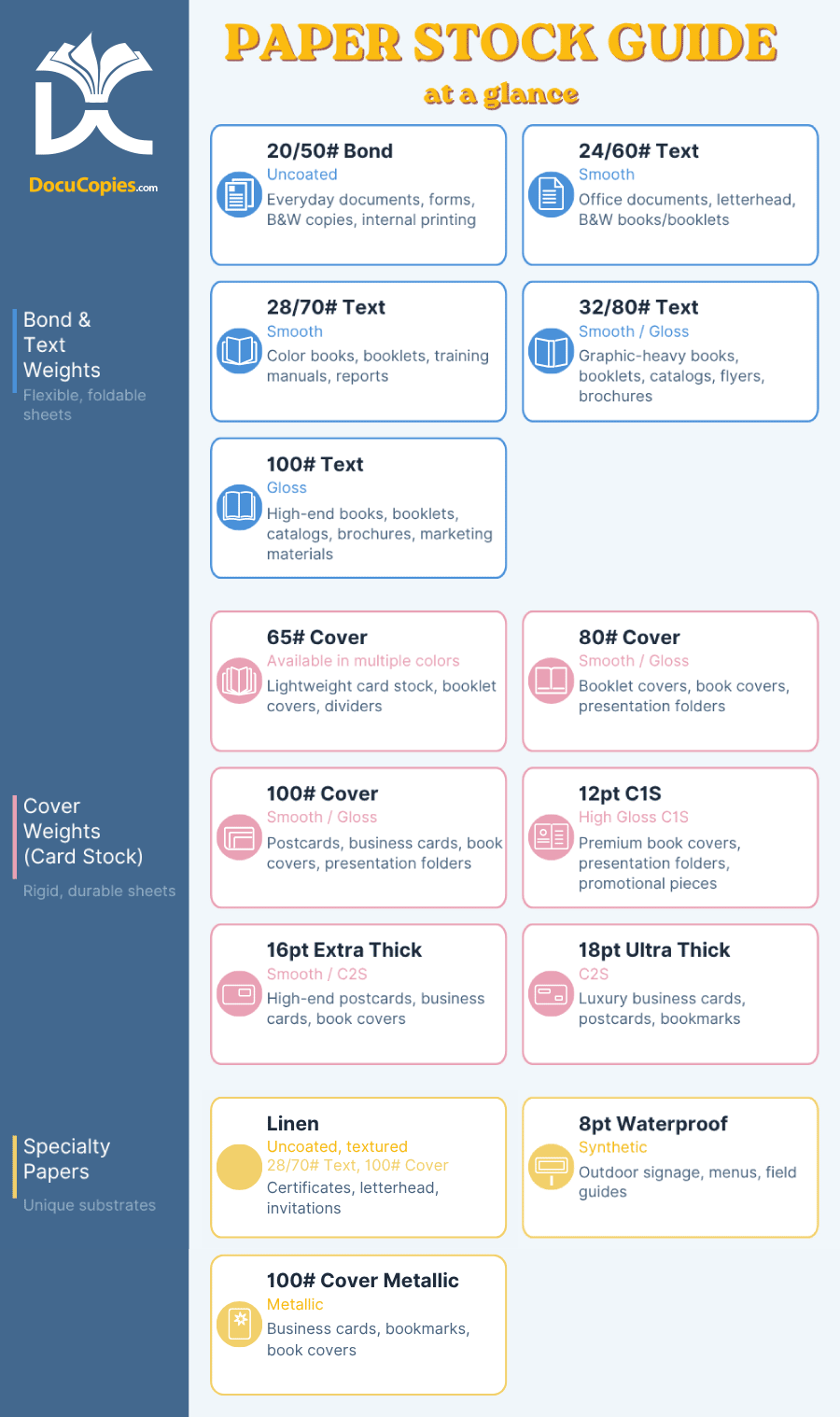
Prefer a more visual illustration? Click out our cheat-sheet infographic:

Paper Weights, Finishes & Best Uses at a Glance
Use this table to quickly compare paper weight, finish, and recommended uses for common digital printing paper stocks. Read more details after the table.
| Paper Weight | Finish / Type | Best Uses |
|---|---|---|
| Text & Bond Weights — Flexible, foldable sheets | ||
| 20/50# Bond | Uncoated | Everyday documents, forms, internal printing, B&W copies |
| 24/60# Text | Smooth | Office documents, economical book pages, letterhead |
| 28/70# Text | Smooth | Book pages (most popular), manuals, reports, professional correspondence |
| 32/80# Text | Smooth / Gloss | Premium documents, color brochures, catalogs |
| 100# Text | Gloss | Flyers, brochures, menus, color-heavy marketing handouts |
| Cover Weights (Card Stock) — Rigid, durable sheets | ||
| 65# Cover | Smooth / Gloss | Lightweight card stock, short-run booklet covers, dividers |
| 80# Cover | Smooth / Gloss | Booklet covers, book covers, presentation folders |
| 100# Cover | Smooth / Gloss | Postcards, business cards, book covers, sell sheets |
| 12pt C1S | High Gloss C1S | Photo-like postcard fronts, premium book covers, luxury promo pieces |
| 16pt Extra Thick | Smooth / C2S | Premium postcards, direct mail, business cards, high-end marketing |
| 18pt Ultra Thick | C2S | Luxury business cards, ultra-premium postcards, high-end branding |
| Specialty Stocks | ||
| Linen | Uncoated, textured | Certificates, letterhead, invitations, upscale business materials |
| 8pt Waterproof/Tearproof (Synthetic) | Outdoor signage, menus, field guides, healthcare, construction | |
Everyday Documents and Forms
20/50# Bond, 24/60# Text Smooth
- Best for black and white documents, forms, and internal office printing
- Lightweight, economical, and easy to write on
- Common uses include invoices, contracts, drafts, and everyday copies
Premium Documents and Letterhead
28/70# Text Smooth, 32/80# Text Smooth
- Best for professional documents, resumes, and letterhead
- Thicker and smoother for a more polished look and feel
- Common uses include business correspondence, reports, and presentations
Booklets, Manuals and Multi Page Documents
28/70# Text Smooth, 32/80# Text (Smooth or Gloss)

- Best for book printing, manuals, catalogs, and newsletters
- Durable enough for frequent handling without adding too much bulk
- Smooth finish is easier to read and write on
- Gloss finish enhances images and color
80# Cover, 100# Cover (Smooth or Gloss)
- Best for book and booklet covers
- 80# Cover is adequate for shorter booklets, while thicker books benefit from the heavier 100# Cover
- Smooth finish is easier to read and write on
- Gloss finish enhances images and color
Flyers, Brochures and Marketing Materials
32/80# Text Gloss, 100# Text Gloss
- Best for flyers, brochures, menus, and handouts
- Sturdy and professional with a noticeable upgrade in weight
- Gloss finish provides vibrant color and sharper images
Postcards and Direct Mail
100# Cover (Smooth or Gloss), 16pt Extra Thick (Smooth or C2S)
- Best for postcards, direct mail campaigns, and premium handouts
- Thick, rigid stock designed to stand out and feel substantial
- C2S coating adds a slightly glossy finish on both sides for bold visuals
Ultra Premium Cards and High End Prints

18pt Ultra Thick C2S
- Best for luxury postcards, business cards, and high end marketing pieces
- Extra rigidity and durability for a premium impression
- Ideal when presentation and perceived value matter most
Durable and Outdoor Applications
Waterproof and Tearproof Synthetic Paper
- Best for menus, outdoor signage, field manuals, and ID sheets
- Resistant to water, tearing, and heavy wear
- Great for restaurants, construction, healthcare, and other demanding environments
How to Choose Paper for Printing
Follow these six steps to select the right paper weight, finish, and coating for any custom print project.
- Understand paper weight. Paper weight (listed in pounds) describes how heavy and sturdy a sheet is. Lighter bond and text weights (20–32#) are flexible papers used for documents, books, and flyers. Heavier cover weights (65–130#) are stiffer card stocks used for postcards, business cards, and book covers. Higher point (pt) thickness values indicate a thicker, more rigid sheet.
- Choose a surface finish. Uncoated papers (bond, smooth, linen) have a matte-like surface that reduces glare, reproduces text cleanly, and accepts pen and pencil easily. Coated papers (semi-gloss, C1S, C2S) have a light to high-gloss coating that enhances color saturation and image contrast. Choose uncoated for text-heavy or writable pieces; choose coated for photos, marketing materials, and anything where color impact matters.
- Match paper weight and finish to your project type. For book pages and multi-page documents, use 24/60# or 28/70# Text Smooth. For color or photo-heavy pages, upgrade to 32/80# or 100# Text Gloss. For brochures and flyers, 100# Text Gloss or 100# Cover Gloss are common choices. For postcards and business cards, 100# Cover Smooth/Gloss or 16pt C2S are standard; use 12pt C1S High Gloss for a photo-like front. For book covers, use 80# or 100# Cover Smooth/Gloss or 12pt C1S.
- Consider writability if needed. If your piece needs to be signed, filled in, or written on — such as autograph pages, forms, or certificates — use an uncoated stock. All semi-gloss papers except 12pt C1S can be written on with ballpoint pen, but ink may smear briefly before drying. Pencils do not work well on coated papers.
- Request samples or a hard copy proof. If you're unsure how a stock will look or feel in hand, request paper samples from your printer or order a hard copy proof before committing to your full print run.
- Use the order form to price your selection. Once you have identified the right paper type, enter your specs on the DocuCopies.com order form. Paper stock options and their prices are listed in the order calculator. Changing your paper selection updates the price in real time so you can compare options before ordering.
Frequently Asked Questions About Printing Paper
What paper weight is standard printer paper?
Standard printer paper is 20/50# Bond. This is an everyday, economical paper stock suitable for basic documents and internal printing.
More details...
A step up is 24/60# Text Smooth, which offers better opacity, a more uniform surface, and noticeably less ink show-through on double-sided prints. For most offices, 24/60# hits the sweet spot between economy and quality.
What is text weight paper?
Text weight paper is a category of lighter, flexible paper ranging from 20/50# Bond up to 100# Text Gloss. Commonly used for book pages, booklets, brochures, and flyers.
More details...
Text weight stocks are thinner and more pliable than cover weight, making them easy to fold and ideal for multi-page documents. Lighter options (20-28#) work best for reading and writing; heavier text weights (32/80#, 100#) add body and work well for color-heavy content.
What is cover weight paper?
Cover weight paper (also called card stock) is a heavier, more rigid paper used for book covers, postcards, business cards, and any item that needs extra durability and stiffness.
More details...
Cover weights typically range from 65# up to 18pt Ultra Thick. The added thickness gives printed pieces a premium, professional feel and helps them hold up to mailing and repeated handling. If in doubt between text and cover, choose cover for anything that stands alone (a postcard, a card, a cover) and text for anything that folds or stacks (interior pages, handouts).
What paper is best for printing photos or color-heavy graphics?
For color-heavy pages, 32/80# Text Gloss or 100# Text Gloss are the best choices. The semi-gloss coating significantly improves color saturation and image sharpness.
More details...
For card stock applications like photo prints or premium marketing pieces, Cover Gloss provides a balanced semi-gloss finish, while 12pt C1S High Gloss delivers a photo-like, highly reflective surface that makes colors pop. If you want extra weight and rigidity to match the premium feel of the print, 16pt or 18pt C2S are worth the upgrade.
What is the difference between matte and smooth paper?
Smooth paper and matte paper look similar, but smooth has a more refined, uniform surface that produces sharper text and cleaner images, making it the better choice for most print projects.
More details...
Both are uncoated, low-glare, and easy to write on. Matte paper has a flatter, slightly more textured feel that some designers prefer for an understated, editorial look. For everyday documents, booklets, and professional reports, smooth paper is usually the stronger performer.
What does C1S and C2S mean on paper stocks?
C1S means Coated One Side (glossy front, uncoated back) commonly used for postcards and book covers. C2S means Coated Two Sides, meaning both faces have a coating for consistent color and finish, preferred for menus, business cards, and two-sided marketing materials.
More details...
C1S is commonly used for postcards, book covers, and promotional pieces where high-quality image reproduction is needed on the front and the uncoated back makes it easier to write addresses or notes. C2S is preferred for menus, business cards, and two-sided marketing materials where consistent color and finish matter on both faces.
What paper stocks are best for postcards and business cards?
The most popular choices for postcards and business cards are 100# Cover Smooth and 100# Cover Gloss. Both provide a sturdy, professional feel at a standard card stock thickness.
More details...
For a more premium product, 16pt C2S adds extra rigidity, and 18pt Ultra Thick C2S is the heaviest option we offer — ideal when perceived quality is the top priority. If you want a photo-like glossy front, 12pt C1S High Gloss delivers a bright, reflective finish on one side.
What is large format printing?
Large format printing (also called wide format printing) refers to printing on materials 24" wide or larger. This includes large posters, banners, canvas prints, and adhesive signage.
More details...
Large format printers use different technology and media than standard digital presses, including photo semi-gloss, high-gloss, vinyl, canvas, and self-adhesive materials designed for display-quality output. If your project needs to be seen from a distance or displayed outdoors, large format is the right category to explore.
What paper should I use for book pages?
For text-heavy book pages, 28/70# Text Smooth is the most popular choice. This stock offers bright white opacity and minimal show-through on double-sided pages at a reasonable cost.
More details...
For lighter-budget projects, 24/60# Text Smooth is a solid economical option. If your book includes heavy color content or photos, upgrading to 32/80# Text Gloss or 100# Text Gloss will significantly improve image quality with a semi-gloss finish that gives pages a magazine-like look.
What is the difference between gloss and semi-gloss paper?
Semi-gloss paper has a moderate shine that enhances color while reducing glare; high-gloss paper (like 12pt C1S) has a bright, highly reflective coating that produces a photo-like finish.
More details...
Most gloss-labeled stocks we carry are technically semi-gloss — they're well-suited for professional marketing materials, brochures, and booklets. High gloss is best reserved for projects where vibrant visual impact is the top priority, such as photo cards, luxury postcards, or promotional covers.
 Processing...